


It seems cold to ask it now, today, but I’ve a reason. Did we love the World Trade Center for what it was, or what it came to mean?
Paul Goldberger, the architecture critic for the New York Times, had it right: one tower would have been rather banal, but two towers had the appearance of abstract sculpture. In a 2004 lecture he spoke of his initial reaction:
The first phase we could call Resentment: what was this thing, or this pair of things, doing here, so big, so banal, so unthinkably intrusive, all the more insulting because it is taking away the title of tallest building that everyone knows rightfully belongs to the Empire State Building.
He wasn’t alone. A lot of people thought the buildings were too big. In 1967, the Committee for a Reasonable World Trade Center ran this ad, demanding the project be downscaled.
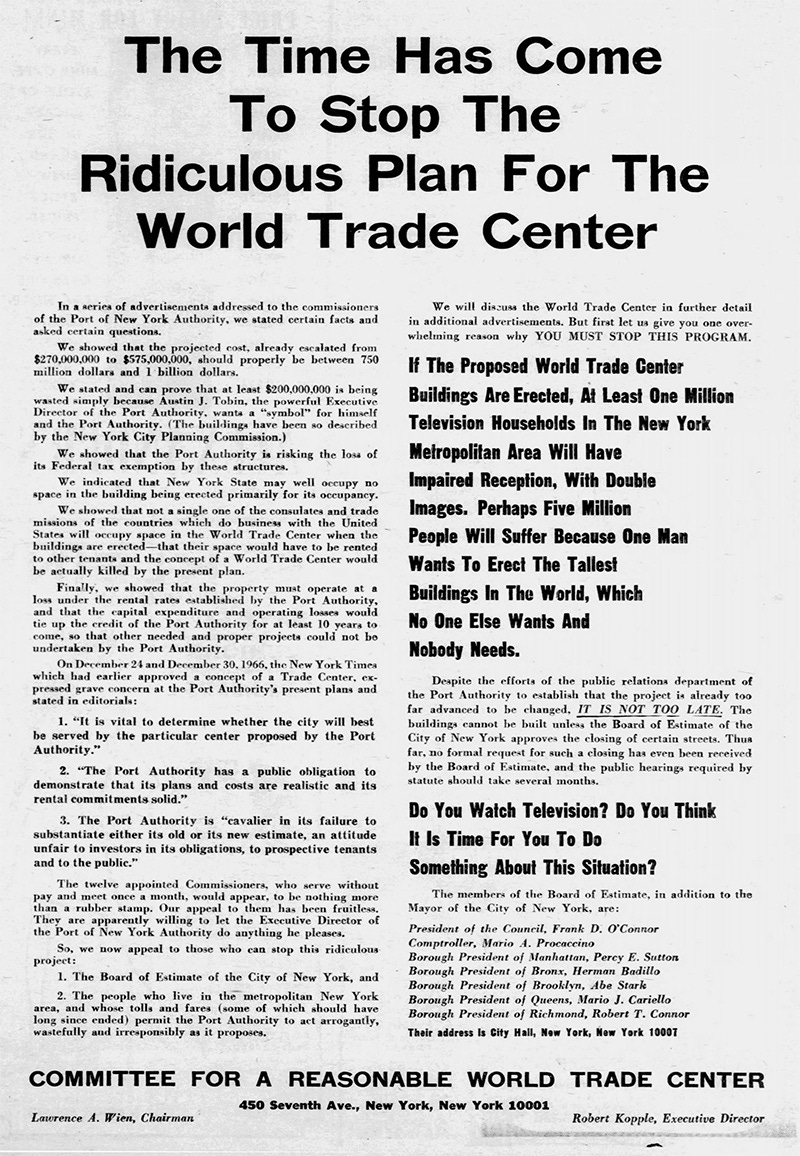
The main reason:
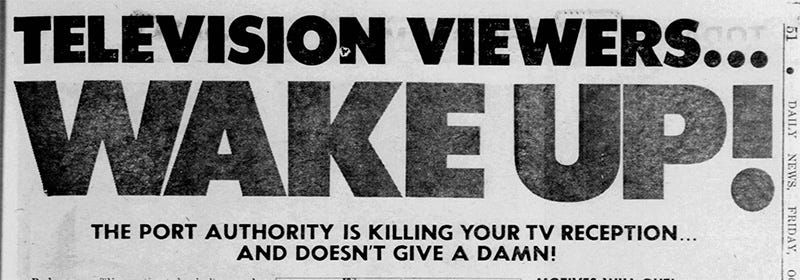
Critics said it would interfere with the quality of New Yorkers’ TV reception. (It did.)
Goldberger came to accept, grudgingly, the WTC’s role as a landmark, the shifting attributes that varied depending on the light, the wise decisions to place them at angle to each other instead of side by side. But he never ended up admiring them, and in his 2004 remarks noted that its final role was not love, but respect for its martyred status.
Of course, the WTC could have been worse. An indistinguishable duo of black Miesian boxes would have been an admission that architecture had run out of ideas entirely. If they’d been sheathed entirely in mirrored glass they might have seemed oddly insubstantial for their bulk and height. What would have worked best? Perhaps something from the mind of Hugh Ferris, something that tapered or fizzed as it reached to touch the hem of heaven.
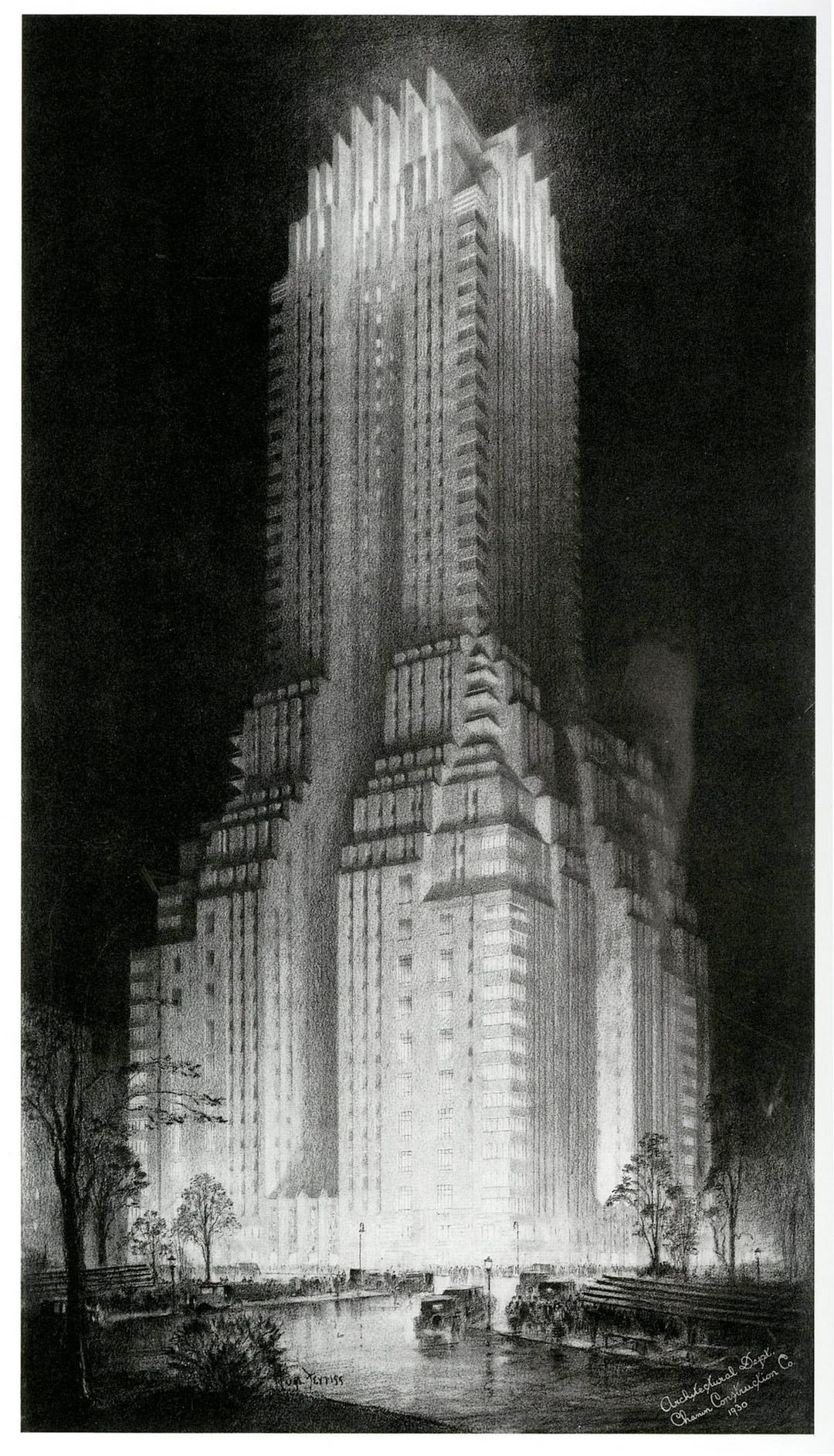
But we had long since lost that sense of majesty and romance.
I am not an admirer of the replacement, the Freedom Tower. It is monumental; I’ll give it that. But I can’t help read the design as a series of triangles that rise up to a point interspersed with triangles that push all that aspirational energy back down.
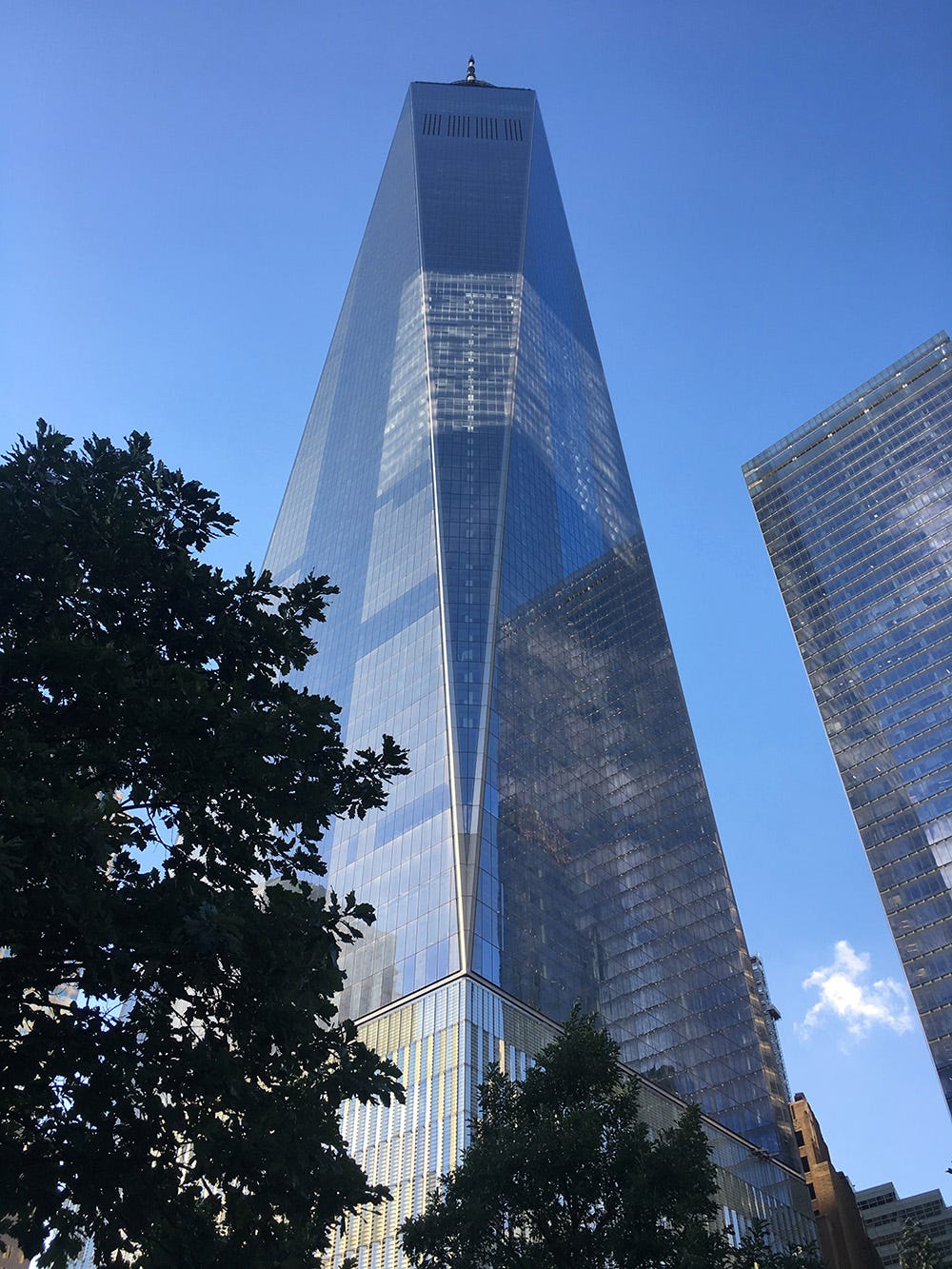
Modern skyscraper design is all about avoiding the plain box, but since there is no dominant style, no general cultural consensus what a modern skyscraper should look like, every new supertall looks like a proposal for a new idiom that’s never adapted by anyone else. They’re all one-season Netflix shows that don’t get renewed.
After the towers fell, many people thought the replacement should be exactly what was knocked down, and despite my feelings about the buildings, I agreed. It would be a rebuke to the evil that took them down. What stands on the spot now, though, is possibly the most depressing memorial in the history of Western Civilization. Other memorials have a touch of the heroic - the general may have fallen in battle, but here he is on his horse, eyes to the horizon. This may have been the scene of a horrible battle, but allegorical figures gather up the grief and mold it into virtue. Again, we’re not in the mood for that anymore, or, if we are, the cultural gatekeepers decline to provide them.
There is nothing heroic in the 9/11 memorial, nothing that offers consolation or resolution. A black pit the dimensions of the tower, the water pouring to another black well without a bottom. Endless, unceasing, unsparing loss.
It may be the most depressing memorial, but it is also the most powerful.
We don’t necessarily miss the buildings as much as we miss their presence, which we presumed was eternal. We might have began to love them them moment they were struck. I still remember thinking they could repair the first one, despite the fire. I remember thinking, when the first one fell, that the other might survive as a tribute to its brother. At day’s end you didn’t know what might rise on the spot, if anything, ever.
I watch this video every year. I cobbled it out of DVR grabs a few days after the event. My cheerful child playing on the floor, holding out a phone that has Elmo’s voice calling out. My old dog, sensing something amiss. A quarter of a century away. Close to the heart as if it happened this morn.
No matter how you felt about the towers, and being raised in NY, I never thought much about them one way or another - they were OURS. And someone destroyed them. That changes everything - forever.
The video brought it all back for me. 8 min well spent. Thank you, James.
Soon after 9/11 I discovered your work, as we all struggled as a nation to make sense of the senseless. I am so glad that I had your perspective and support as history unfolded. My child was born in November of 03 and your column was like a preview of things to come as events and milestones passed us by. I am truly grateful for your talent. Well said, as always.